KINGSTON EIFSREPAIR · RECOAT · INSTALL (home) (845) 443-7902 Free estimate

Homeowner & property manager guide · Kingston EIFS

8 signs your EIFS has water behind it

Because synthetic foam and fiberglass mesh do not rot when wet, an EIFS wall can hide damp plywood or OSB sheathing behind an intact outer crust. Walking your building twice a year to look for these eight clues catches leaks while repairs are still small.

Updated November 2026

1. Dark wash marks beneath bottom window corners

Step back and check the two lower corners of every window, especially on two-story elevations without deep roof overhangs. Diagonal or vertical dark tracks starting right at the sill corner often mean mitered vinyl or clad window frames are leaking internally, or water is bypassing cracked perimeter caulk without a sill pan underneath to kick it back out.

2. Missing kick-out flashing where a roof meets a taller wall

Look closely at every spot where a lower garage, porch or dormer roof dies partway into a higher EIFS wall. There should be an angled metal diverter—a kick-out flashing—turning water away from the cladding and into the gutter. On many 1990s Ulster County houses, the EIFS was grooved right around the roof shingles with no diverter at all, funneling roof runoff straight behind the foam.

3. Spongy give or hollow delamination when pressed

Dry EIFS sounds hollow when tapped with a knuckle, yet the fiberglass-reinforced crust should feel firm and taut under light thumb pressure. If an area below a window, deck ledger or trim band flexes inward noticeably, crunches softly or rocks like loose cardboard, the wood sheathing behind the foam may be wet or deteriorated, or the adhesive bond has let go.

4. Split or stiff caulk around windows, vents and lights

Run your eye along the joint between the EIFS return and window frames, door jambs, dryer vents, hose bibs and exterior light blocks. When old caulk shrinks, hardens or tears away from the textured edge—often because it was gunned straight into a narrow gap without closed-cell backer rod—wind-driven rain enters behind the insulation every storm.

5. Foam run down into soil, mulch, asphalt or roofing

EIFS needs breathing room above horizontal surfaces. Where foam board runs straight down into flowerbed mulch, touches concrete patios or sits tight against roof shingles and wooden deck ledgers, melting snow and splash-back stay trapped against the bottom edge. Buried foam wicks water upward and hides carpenter-ant or termite entry paths.

6. Round woodpecker holes and unsealed impact punctures

In wooded towns like Woodstock, Hurley, Saugerties and Stone Ridge, woodpeckers love drumming on hollow EIFS bands and gables. Even a dime-sized hole punches clean through the waterproof base coat into bare white expanded polystyrene, allowing rain, wasps and nesting birds inside the wall assembly until it is plugged and re-meshed.

7. Blistering finish, algae bands or rust-colored weeping

Surface mildew in deep tree shade can be purely cosmetic, yet concentrated green algae bands in an otherwise sunny spot often trace a slow, steady leak keeping that patch of lamina damp. Pimples or water-filled blisters in the acrylic coat, chalky efflorescence lines or rust-colored streaks weeping from a joint point to moisture pushing outward from wet fasteners or wet framing behind the board.

8. Musty odors or stained drywall below exterior openings

Because exterior sheathing, cavity insulation and drywall sit inside the EIFS layer, indoor symptoms usually show up last. Peeling paint on interior window stools, darkened baseboards, soft drywall corners or a damp smell after heavy rain indicate a leak that has already crossed the wall framing and needs prompt EIFS repair.

What to check yourself and when to open a test cut

Walk your house or commercial building with binoculars in spring and fall, paying extra attention to roof-to-wall intersections, flat architectural foam bands without metal drip caps, and window sills. Avoidjabbing screwdrivers or unsealed probes into suspect areas, which only opens new leaks.

We are an EIFS repair contractor, not a licensed home inspector. When photos or surface checks point to trapped moisture, we probe carefully at concealed points and, where needed, open a clean test cut with your approval so you can see photos of the sheathing condition before choosing between localized patching and drainage EIFS re-cladding.
Quick reference: surface symptom, entry point and repair

How visible clues on the outside of an EIFS wall connect to what is happening behind the foam.

Spongy give under thumb pressure

The wall flexes inward or feels soft beneath intact acrylic texture around openings.

Usually means
Prolonged moisture softening OSB or plywood sheathing behind barrier-style foam.
What we do
Cut out the affected section, replace rotted sheathing, correct the leak source and rebuild lamina.

Forty-five-degree corner cracks

Diagonal cracks radiating from window sills, headers, louvers or storefront frames.

Usually means
Thermal movement or omitted diagonal fiberglass mesh reinforcement at opening corners.
What we do
V-groove or cut back if damp, embed diagonal butterfly mesh in polymer base coat and finish.

Separated perimeter caulk

Hard, shrunken caulk pulled loose from the textured EIFS return around frames and vents.

Usually means
Aged sealant or three-sided adhesion installed without closed-cell backer rod.
What we do
Remove old caulk cleanly, set proper backer rod and tool low-modulus perimeter sealant.

Blisters along upper commercial bands

Bubbling finish or rust-colored weeping near flat roofs, canopies or tenant signage.

Usually means
Open parapet coping seams or unsealed sign-conduit bolts feeding water behind the board.
What we do
Seal parapet metal and penetrations first, strip blistered areas to dry backing and recoat.
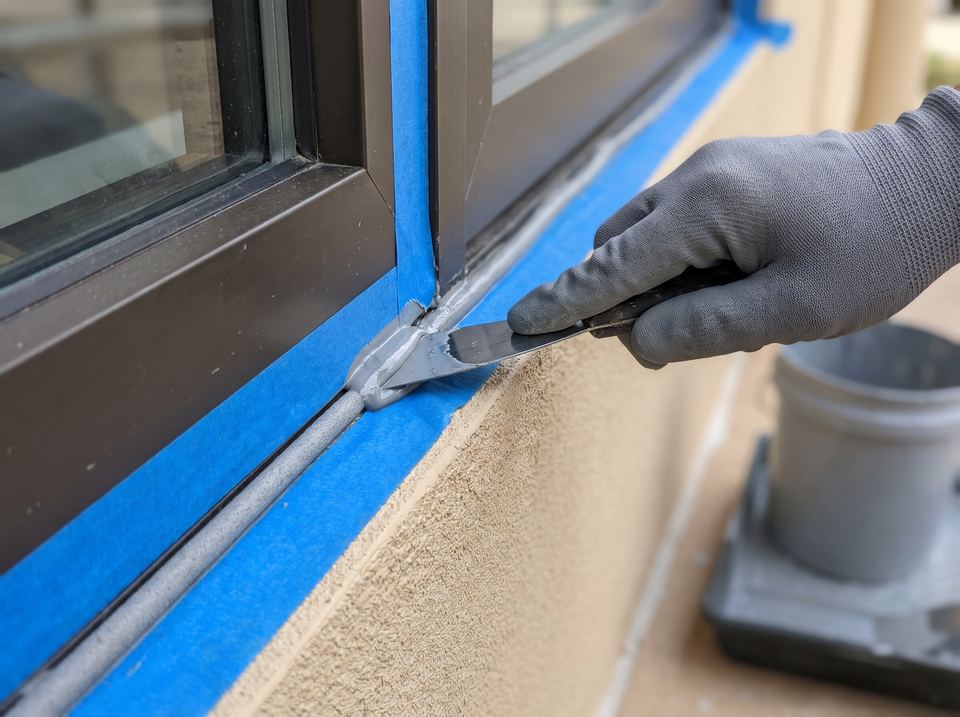
AI-generated illustration: a sealant bead tooled over backer rod where an EIFS wall meets a window frame

AI-generated illustration

AI-generated illustration: a properly backed two-sided sealant joint around a window frame prevents corner leaks into EIFS.

Moisture check and homeowner inspection questions

Do dark streaks below window corners always mean water is behind the EIFS?

Not every smudge indicates wet sheathing, because rainwater washing airborne dust off window glass naturally concentrates at the two bottom corners of a sill. However, missing window sill-pan flashing and split miter joints leak at those exact same corners. Checking whether the sealant joint is open and whether the wall below feels spongy distinguishes surface dirt from hidden moisture.

Should I push hard on soft EIFS spots or poke holes to check for water?

Gentle thumb pressure is enough to tell whether foam has pulled loose from soft sheathing; pressing hard can crack intact brittle lamina unnecessarily, and poking unsealed holes lets rainwater straight into dry insulation. Professional moisture probing uses tiny pin openings at concealed sill or base edges that are immediately sealed with compatible caulk once readings are taken.

Why can an EIFS wall rot wood sheathing behind it without crumbling on the outside?

Unlike brick mortar or traditional cement stucco that cracks and spalls visibly as masonry shifts, EIFS uses flexible polymer-modified base coat reinforced with woven fiberglass mesh over synthetic foam board. Neither the plastic foam nor the fiberglass mesh rots when wet, so the outer skin often bridges across decaying OSB or plywood until framing fasteners finally lose grip.

What happens if EIFS touches mulch, soil or patio pavers along the foundation?

Foam insulation and polymer base coat buried in mulch or resting on concrete slabs stay damp after rain and snowmelt, allowing moisture to wick upward into sill plates and rim joists. Buried foam also creates a sheltered, unseen path for carpenter ants and termites between soil and wood framing. Cutting the EIFS back above grade restores necessary clearance.

Can interior drywall look completely dry even when exterior EIFS sheathing is wet?

Yes. Exterior plywood or OSB sheathing, fiberglass stud-cavity insulation and interior vapor retarders sit between the back of an EIFS wall and your painted living-room drywall. Moisture trapped behind barrier EIFS can soften exterior sheathing around a window opening for several seasons before enough water crosses the stud cavity to stain interior trim or paint.

Seeing one of these warning signs? Send us photos

Attach a close-up of the spot and a wide shot of the whole wall for a free read.

Rather text? Text photos to (845) 443-7902

What are you seeing? (optional)
Add details (optional)
Property (optional)
How soon? (optional)
Best way to reply (optional)
Photos (optional, up to 5)

Add 3–5 photos: one close-up and one of the whole wall. We shrink them before sending.

    required. We reply within one business day, Monday to Friday. We use your details only to reply to this request. Privacy

    Rather text?

    (845) 443-7902

    Call or text Monday–Friday, 7 AM–5 PM.

    Next steps if your wall has moisture

    Unsure whether a stain is cosmetic or wet behind the board?

    Book spring work now. Winter assessments and estimates available.