EIFS repair · Kingston & Ulster County
EIFS and Dryvit repair in Kingston and Ulster County
Cracked window corners, woodpecker holes, dark sill streaks and spongy foam usually trace back to missing flashing or failed sealant. Fix the water entry point at the same time and a sectional EIFS repair holds up.
Book spring work now. Winter assessments and estimates available.
Updated November 2026
Short answer
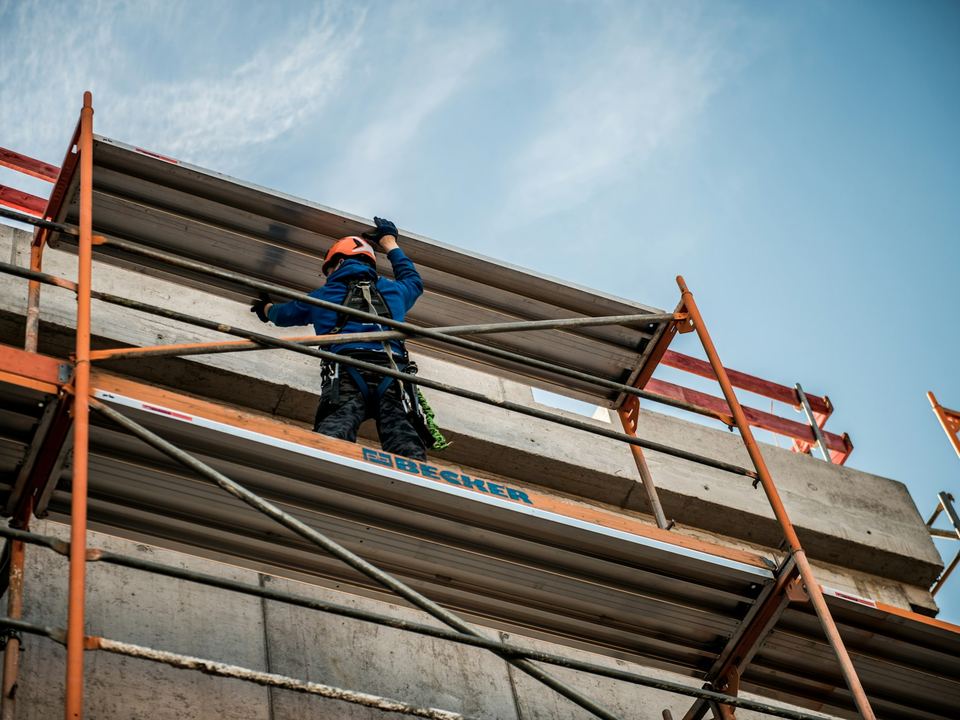
Most damaged EIFS walls around Kingston can be repaired in targeted sections rather than torn off completely. Our crew cuts back wet or cracked foam, inspects the sheathing, installs missing kick-out or drip flashing, replaces failed perimeter sealant, and rebuilds the reinforcing mesh, base coat and textured finish. Finish work requires 40 °F and rising. Text two daylight photos for a free estimate.
Key facts
- Service area
- Kingston and Ulster County: Saugerties, Port Ewen, Rosendale, Hurley, Woodstock, Stone Ridge and New Paltz.
- Season
- EIFS and stucco finishes need about 40 °F and rising, with no freezing for 24 hours. In the Hudson Valley that means spring through late fall.
- Who does the work
- Our own crews, from The Dom Construction Group LLC.
- Insurance
- General liability, umbrella and workers' compensation insurance; certificates on request.
- Estimates
- Free. Start with 3–5 photos by text, or use the form.
- Reply
- We reply within one business day, Monday to Friday.
Damage we cut out, flash and rebuild
Exterior insulation and finish systems pair foam board with a thin, fiberglass-reinforced polymer base coat and a textured acrylic finish. That outer skin sheds rain reliably on open wall planes, yet any unsealed break at an edge or penetration feeds water straight into the insulation layer. Across Kingston and Ulster County we repair:
- Window and door corner cracks, where thermal movement or missing diagonal reinforcing mesh splits the lamina at forty-five degrees
- Wet, spongy or bulging wall sections under window sills, mitered frames, balconies and deck ledgers
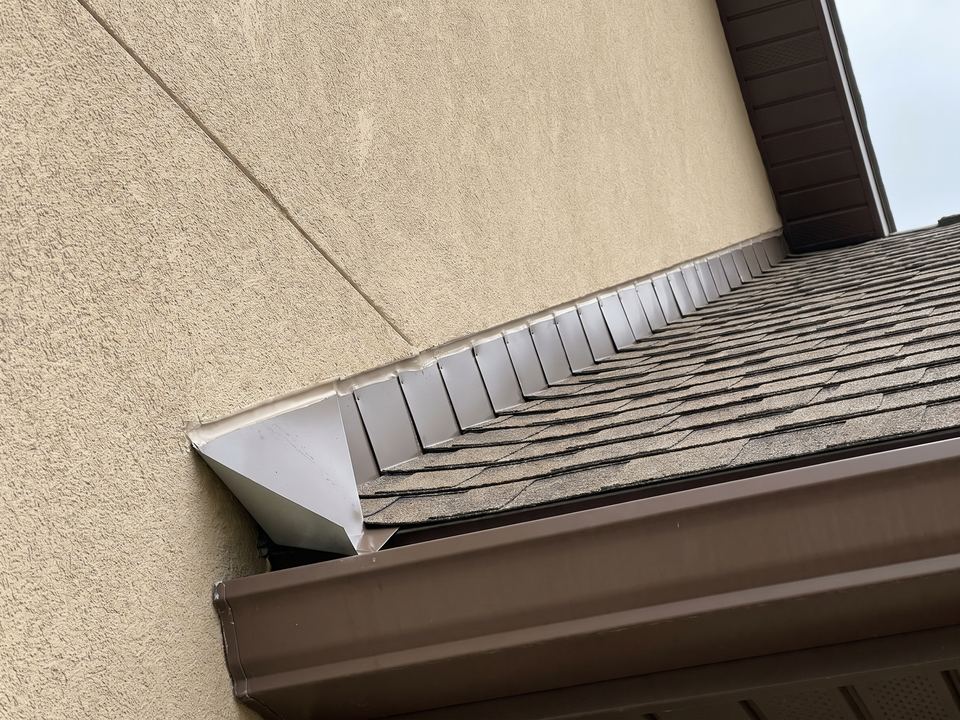
- Missing kick-out and drip-cap flashings, including flat decorative foam bands that hold standing snow and rainwater against the wall, like a residential EIFS band repair with a new drip cap we completed in Schenectady in 2026
- Woodpecker holes and impact punctures from ladders, falling branches, mowers or snowplows that expose bare white foam to weather and nesting birds
- Split or stiff perimeter caulk around windows, vents, hose bibs and exterior light blocks where three-sided adhesion tore the edge of the finish coat
- Low EIFS terminations carried straight down into mulch, soil, pavers or roof shingles where capillary action wicks moisture upward
Finding wet sheathing before quoting the repair
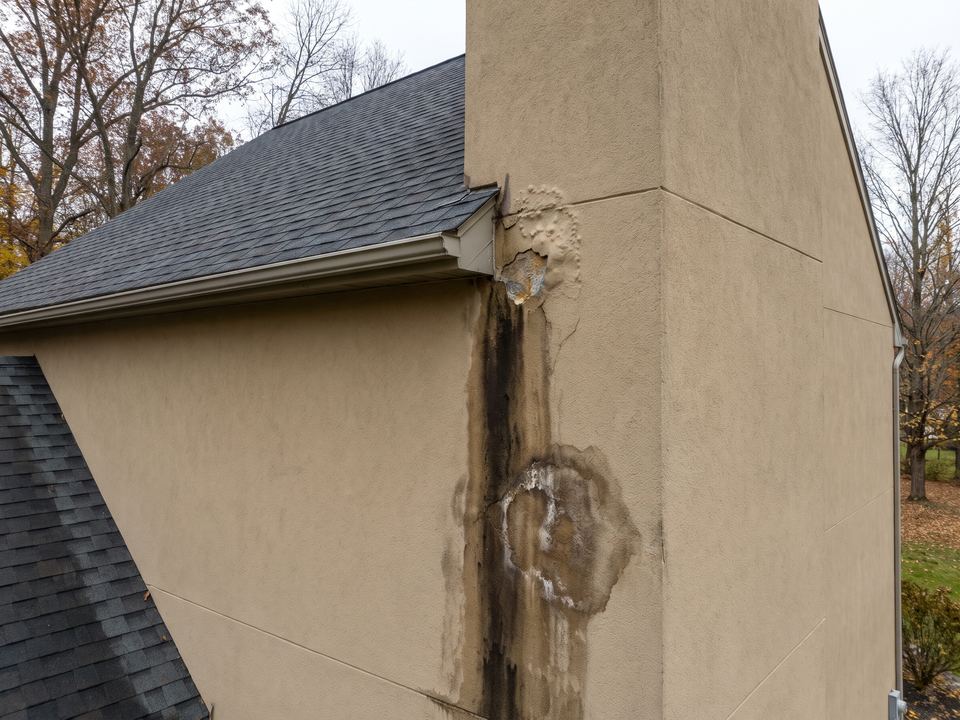
Patching over damp plywood or oriented strand board wastes money because trapped moisture pushes the new base coat loose during the next winter freeze. Before finalizing a repair boundary, we trace how water travels down the elevation from roofs, gutters, sills and trim bands, then probe suspect spots around openings and base terminations.
We are a repair contractor, not a licensed home inspector, so our focus is practical: separating dry foam that only needs surface mesh and finish from wet substrate that has to come off. When we open a damaged section, we photograph the sheathing and framing condition so you can see clearly why a cut-out stops where it does. To see what you can spot from the ground first, read our guide to 8 signs your EIFS has water behind it.
Blending texture and deciding when a wall needs more
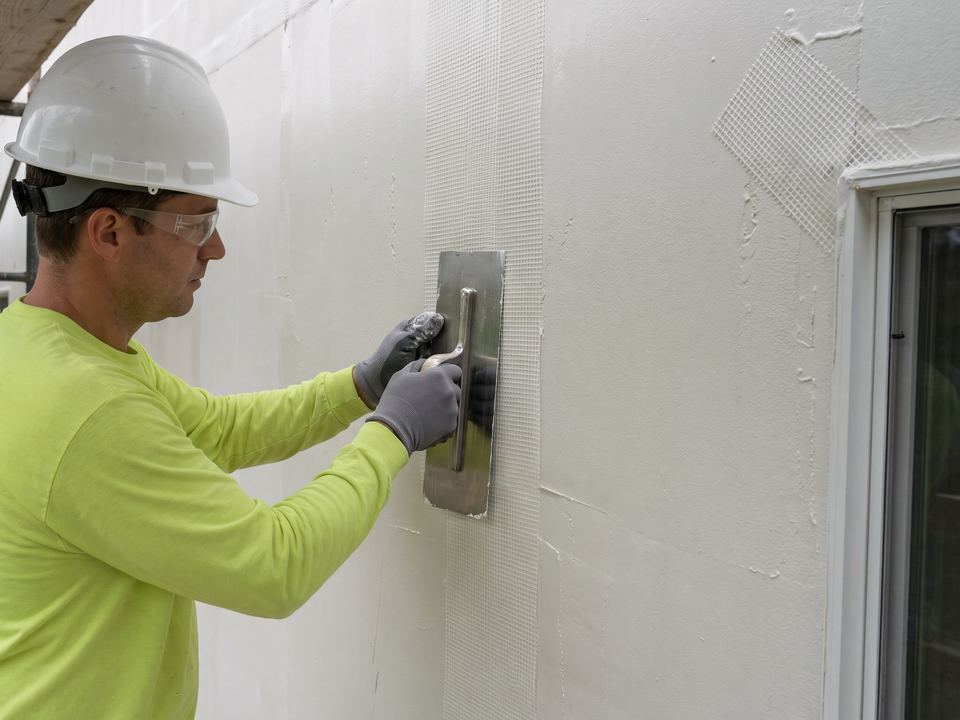
After bad sheathing is replaced and sheet-metal flashing is corrected, we fit new expanded polystyrene board, back-wrap exposed terminations, embed alkali-resistant fiberglass mesh into polymer base coat, prime the patch and float an acrylic finish selected to match the surrounding aggregate size and swirl pattern. Whenever wall geometry allows, we run the finish out to a natural break such as an expansion joint, corner return or architectural reveal.
Fifteen or twenty years of sun will shift any original acrylic color slightly, which means a small patch in the middle of a broad, sunlit wall can still show a subtle shade difference. If uniform curb appeal matters on a faded facade, we also price corner-to-corner EIFS cleaning and recoating. When probing reveals widespread substrate decay across most of an older barrier system, stripping the elevation for new drainage EIFS is often better money, and we lay out both numbers side by side.
Typical price ranges for EIFS repairs
Localized surface work, such as filling woodpecker holes, repairing an impact dent or re-meshing short dry cracks, typically runs from a few hundred to a couple of thousand dollars. Moisture cut-outs that involve scaffolding, rotted sheathing replacement, new kick-out or head flashings and multi-coat blending cost more depending on area and wall height. Acrylic finish coats and sealants need temperatures around 40 °F and rising with no freezing for 24 hours, generally spring through late fall, while estimates and site evaluations run all year.
Where roof runoff slips behind the foam
AI-generated illustration
AI-generated illustration
AI-generated illustration
Answers on Dryvit and EIFS moisture repairs
Does moisture damage on one wall mean the entire house needs new siding?
Usually not. Water entry on EIFS houses is often concentrated below specific window corners, under un-flashed roof-to-wall intersections or along a single deck ledger while broad stretches of wall remain completely dry. By probing around suspect openings first, a crew can cut back only the wet foam and rotted sheathing, correct the flashing defect and rebuild that localized section.
How do you stop woodpecker holes from turning into bigger EIFS leaks?
Woodpeckers drum on EIFS because hollow foam boards resonate like dead tree bark, and once a hole breaks the outer crust, rain and insects enter the insulation. Small holes are cleaned out, plugged tightly with foam and skimmed with fiberglass mesh, base coat and matching acrylic texture. On repeatedly targeted bands, embedding heavy-duty reinforcing mesh adds extra puncture resistance.
Will a patched EIFS section blend invisibly into an older wall?
Texture size and float pattern can be matched closely, and stopping the repair along architectural reveals, corners or expansion joints hides transitions well. Color is harder on walls that have weathered in direct sun for fifteen or twenty years, because fresh acrylic pigment will look slightly cleaner than aged finish nearby. Coating that full elevation corner to corner eliminates shade differences.
What is kick-out flashing, and why is it missing on so many EIFS homes?
A kick-out flashing is an angled metal diverter set at the bottom end of roof-to-wall step flashing where a sloped roof stops partway across a taller wall. Without that diverter, roof runoff misses the gutter end cap and channels straight behind the EIFS edge. Retrofitting a kick-out requires opening a small pocket of foam and lacing metal into the step flashing.
Are you a licensed home inspector if I am buying an EIFS house in Ulster County?
No. We are an EIFS repair and installation contractor, not a licensed home inspector, and we do not issue home-inspection reports for real-estate closings. What we provide for owners and buyers with owner permission is a practical contractor evaluation of visible cracks, sealant failures, missing flashings and suspect moisture zones, paired with repair scope options and pricing.
Attach photos of your damaged EIFS area
Include one tight photo of the crack, hole or stain and one step-back shot showing the windows or roof above it.
Other EIFS services to compare
- 8 signs of hidden water
Field guide to spotting moisture behind 1990s and 2000s EIFS walls.
- EIFS cleaning and recoating
Uniform color and hairline crack protection across faded elevations.
- Drainage EIFS and re-cladding
Full replacement with water-managed EIFS when old sheathing is wet across the wall.
Spotted a soft corner or woodpecker hole? Text us.
Book spring work now. Winter assessments and estimates available.